






Never Easy
There's nothing simple about addressing anthropogenic climate change.
Earth's chaotic atmospheric dynamics, the mind-numbing intricacies of economic and political forces, and the sheer scope of the problem mean there are no panaceas no one-size-fits-all solutions.
According to a paper just published by researchers at the University of California, Davis, even calculating the carbon dioxide emissions associated with something as seemingly straightforward as chopping down trees is a pretty complicated task.
How Big Is Logging's Footprint?
That logging has a carbon footprint there can be no question. A tree that's no longer photosynthesizing is a tree that's not pulling CO2 out of the air anymore. And CO2 in the air is CO2 warming the planet.
(An acre stand of 25-year-old maples, beeches and birches can sequester some 1,760 pounds of carbon per year!)
The trouble is that past climate models have assumed the environmental impact of clear-cutting five hectares of forest is always the same, regardless of where the tract is located or how the wood is ultimately used.
Wheres And Hows Matter
But, say the UC Davis scientists, because trees in the U.S. and Canada tend to be used for lumber, while trees in the tropics are used for fuel and paper, this assumption of uniformity skews climatologists' predictions.
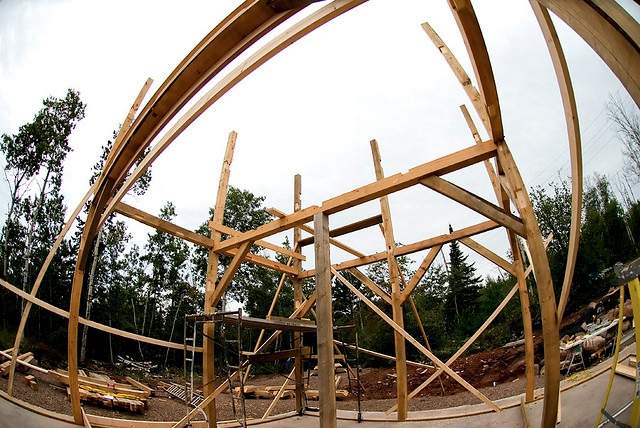
In other words, deforestation doesn't invariably translate to an immediate release of carbon stored in felled trees. Whereas burning a log sends greenhouse gasses into the atmosphere right away, building a deck out of one doesn't.
Sound forecasting and policy-making will require sensitivity to these differences.
Read More:
- Timing of carbon emissions from global forest clearance (Nature Climate Change)
- Time, place and how wood is used are factors in carbon emissions from deforestation (Phys.org)
- Study shows trees absorb less carbon than earlier thought (Phys.org)